Home Buyer Education - Getting Your Finances in Order

First Time Buyers Toronto

The process of purchasing a home in Toronto can be a bit overwhelming, particularly if you are a first-time home buyer.  When we start working with new buyers, we send out weekly ‘buyer education’ emails so that our clients have easy access to important information, and we break it down into digestible chunks so it is not quite so overwhelming.

With that in mind, we thought we would start a series of educational blogs, covering all aspects of the buying process in Toronto.  Since this is the first in the series, we are going to start at the beginning - getting your finances in order!

Pre-approval

First things first, you will need to get pre-approved by your bank or mortgage broker.  This is an important first step because you don’t want to fall in love with your dream home just to find out that the bank won’t lend you the money to buy it!  You will have to provide them with tax returns, proof of income, and a list of all your assets and liabilities.  The lender will then put you through a ‘stress test’ to ensure that you would be able to carry the mortgage even if interest rates rise.  They will approve you based on the rate they are offering plus 2%, or the benchmark rate of 5.25%, whichever is higher.  Here is a handy mortgage affordability calculator to help you determine how much you can afford.  Also important to keep in mind is that there are stricter qualifying requirements for self-employed individuals. 

Whether you go through your bank or a broker, they should walk you through the different products they offer, the difference between a fixed and variable rate mortgage, along with their corresponding interest rates, the varying amortization periods, and pre-payment options.  Once you have been approved for an amount and have decided which product is the best fit for you, the lender will provide you with a pre-approval for that amount at the current interest rate, for a period of 90-120 days.  In the fast-paced Toronto market, this pre-approval is also important because it allows you to submit an offer without a condition on finance.

Mortgage Insurance

A conventional mortgage is considered to be a mortgage with a downpayment of at least 20%.  If the home you are purchasing is over $1,000,000 then a 20% downpayment is required.  If the purchase price is less than $1M and you don’t have 20% to put down, you can put down 5% on the amount up to $500,000 and 10% on the amount between $500,000-$1M.  In this case, the mortgage would have to be insured through CMHC, Sagen, or Canada Guaranty.  You can calculate the cost of the insurance premium here.

First Time Buyer Incentives

Home Buyers’ Plan (HBP)

This government program allows first-time buyers to withdraw up to $35,000 from their RRSPs, without being taxed on it, to buy or build a qualifying home.  The money has to be paid back into your RRSP within 15 years, starting 2 years after the initial withdrawal.  A first-time buyer is defined as someone who has not owned a principal residence or someone who has not owned or sold a home in the past 5 years.  To qualify the home must be a principal residence and the money can be withdrawn up to 30 days after buying a home.  You can find more information on the HBP here.

Land Transfer Tax Rebates

Land transfer taxes are a large expense that must be taken into consideration when purchasing a home.  When purchasing a home in Toronto, buyers are subject to both a municipal and provincial land transfer tax so the amount can be staggering - for example, the LTT on a $1M home in Toronto is $32,950.  Here is a calculator to determine what the land transfer taxes would be based on the purchase price.

First-time home buyers in Ontario can receive a land transfer tax refund of up to $4,000 and first-time home buyers in Toronto can receive an additional municipal land transfer tax rebate of up to $4,475..

First Time Home Buyers Tax Credit (HBTC)

There is also a First Time Home Buyers Tax Credit (HBTC), which offers a $5,000 non-refundable income tax credit amount on a qualifying home acquired during the year. For an eligible individual, the credit will provide up to $750 in federal tax relief.  Learn more here.

First-Time Home Buyer Incentive

The First-Time Home Buyer Incentive helps qualified first-time homebuyers to reduce their monthly mortgage payments without adding to their financial burden.  The program offers 5 or 10% of the home’s purchase price to put toward a down payment.  This portion is a shared-equity mortgage with the Government of Canada which means that the government shares in both the upside and downside of the property value, up to a maximum gain or loss equal to 8% per annum (not compounded) on the Incentive amount from the date of advance to the time of repayment.  The additional down payment lowers mortgage carrying cost, which makes homeownership more affordable.  First-time homebuyers purchasing a home in the Toronto Census Metropolitan Area are now eligible for an increased Qualifying Annual Income of $150,000 instead of $120,000, and an increased total borrowing amount of 4.5 instead of 4.0 times their qualifying income.  Learn more about this program here.

Deposit

Once you have your finances in order, it is time to start looking at some houses!  When you find a home that checks all your dream home boxes and decides to move forward with an offer, there will be a deposit required.  A deposit is different from a downpayment, a deposit is an amount you submit either with an offer (herewith) or within 24 hours of acceptance of the offer (upon acceptance).  This amount is deducted from the downpayment, the balance of which is paid on closing.

In Toronto’s fast-paced market, deposits are often expected herewith so you should be sure to have this money readily available and be available to go to your bank to obtain a draft made out to the listing brokerage.  This deposit is held in trust by the listing brokerage until closing.  Typically a deposit is about 5% of the purchase price.

If you have any questions about purchasing your first (or second or third) home, please feel free to reach out - we are always available for your questions! And stayed tuned for the next blog in our buyer education series.

The Best of Bloor West!

Bloor West Village Toronto

Now that Covid restrictions are lifting, it is time to get out and support our beloved local west end Toronto businesses, who have suffered so much throughout the pandemic. To help you find the best places to eat, play and shop, we are updating our neighbourhood pages and will be highlighting a different west end Toronto area over the next few months. First up is Bloor West Village and Swansea!


AVERAGE SALE PRICE (2021)

detached | $1.87M

semi-detached | $1.35M

TYPE OF HOMES

The neighbourhood consists of mostly detached, 2-storey brick homes with lovely shaded front porches and mutual drives or front pad parking.

Est.

1920’s


fun fact

The Bloor West Village Business Improvement Association was started and spear headed by Alex Ling in 1970. It was the first BIA in the world! The BWV BIA has served as a model for all future BIA's.


bloor west village/swansea schools

Bloor West Village Schools

Runnymede Public School


Public | Runnymede PS (JK-8), Swansea PS (JK-8), Humberside CI (9-12)

French | Runnymede PS (JK-8 - immersion), Swansea PS (JK-8 - immersion/extended), Humberside CI (9-12)

Catholic | St. Pius X (JK-8), St. Cecilia's (JK-8), Bishop Morocco (9-12)


THE BLOOR WEST VILLAGE/SWANSEA NEIGHBOURHOOD

  • restaurants, bars & shopping located along Bloor Street between South Kingsway & Ellis Park

  • easy access to buses on Jane & Runnymede, as well as the Jane & Runnymede subway stations

  • easy commute downtown by highway or TTC & fast access to the airport

  • Runnymede Public Library is located on Bloor Street & Swansea Memorial Library is located on Lavinia Avenue

  • local community theatre, The Village Playhouse, located on Bloor

  • the well known 'Ukrainian Festival' is celebrated every September

  • family-centric & located steps to High Park, great shopping & tree lined streets all make this a highly desirable neighbourhood


Bloor West Village Businesses

A Dark Horse Pub

INDULGE.

  • in delicious Italian food at Queen's Pasta and La Capricciosa and pizza at Bello and Gatto Pizzerias

  • in great coffee at Baka Cafe, Coffee Tree, HotBlack Coffee, ZAZA & The Coffee Boutique

  • in fresh baked treats at Janchenko’s, Bread & Roses, Ma Maison, Bake Sale, COBS or Hot Oven Bakery

  • in a pint at Bryden's, Shakey's or A Dark Horse pubs

  • in Asian food at Ka Chi, Asa and Kenkou Sushi or Yumi Japanese

  • in traditional European fare at Amber European Restaurant, Indian at Bukhara Grill, Latin fare at Bloom, Thai at Simply Thai or Turkish at Flame Food + Design

  • on Jane Street at the delicious Mad Mexican, Queen Margherita Pizza, the French cafe Patisserie 27 or enjoy the charming ambiance at Campo

  • at the popular Annette Food Market on Annette Street

Swansea Town Hall

Swansea Town Hall

PLAY.

Bloor West Village Businesses

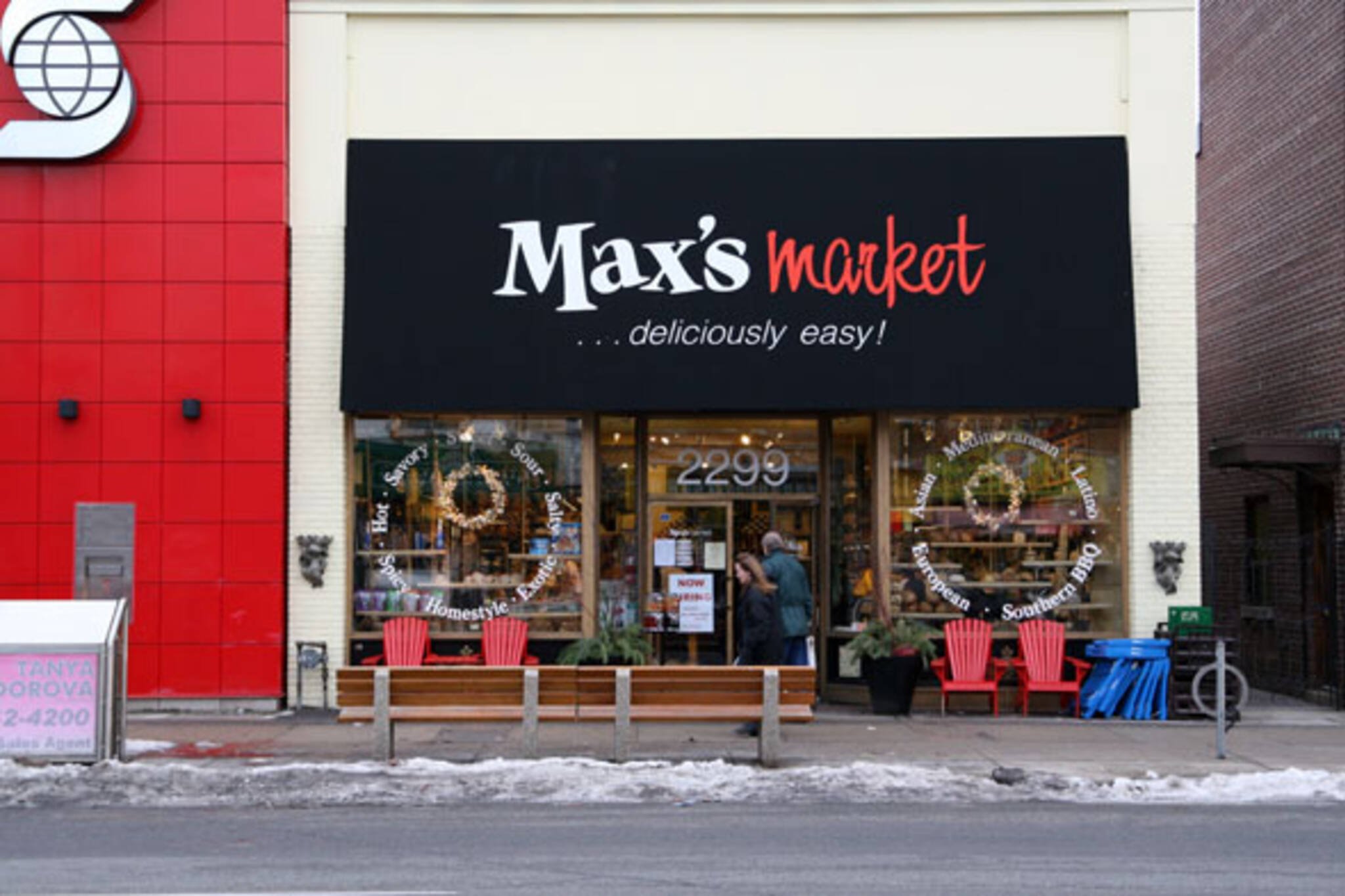
Max’s Market

SHOP.


If you would like more information about this fabulous west end Toronto neighbourhood or if we are missing one of your favourite local businesses, please feel free to drop us a line at info@westsidestoreys.com - we are always available or your quesitons!

Is an Investment Property the Right Investment For You?

Toronto Investment Properties.png

Purchasing an investment property could be the right investment for you if you have maxed out your retirement fund & your children's RESP, your mortgage payments are manageable and you have some extra money that you are looking to invest wisely in order to maximize the return on your investment. Real estate is hot and interest rates are low so purchasing an investment property may seem like a no-brainer, but is it the right no-brainer for you?

I purchased an investment property in Roncesvalles with a friend of mine in 2009, and I have to say it has been a great investment and a good decision, but not without its drawbacks, so best to educate yourself and be prepared before you take the big leap….

Get Your Finances In Order

The banks have different financing requirements for a personal residence than for an investment property. A larger down payment (minimum 20%) is required and the qualifications are more stringent, so make sure to pay a visit to your bank or mortgage broker first to ensure that you qualify.

Pick The Right real estate Agent

Do some homework in this regard and make sure you choose an agent who knows the area where you want to buy, understands the principles of investment properties (cap rates, tax implications, income/expense reports…..more on this later) and has a good grasp on the the local rental market and the rules and regulations set out by the Residential Tenancies Act.

Risk comes from not knowing what you are doing

Warren Buffet

Do You Want To purchase an investment property Alone or with a partner?

I invested with a very good friend of mine and it has worked out well because we are both on the same page. We split the responsibilities and when issues arise with the house we pick up the slack for each other, depending on what is going on in our lives. If you can find someone to invest with, I think it’s great, you only have to come up with half the capital and you can split the workload. However, it doesn’t come without its pitfalls, you have to make sure that they are someone you trust implicitly and that you both have the same long term goals & vision. If you do decide to invest with a friend or family member, have frank conversations about expectations and make sure you see a lawyer to legally document your agreement.  Also, be sure to have this agreement documented in your will as well.

Location, Location, Location

How do you decide where to invest? With the rental market being what it is, it won’t be hard to find tenants pretty much anywhere in Toronto, so the best advice I can give would be to stick to what you know. In other words, buy in an area that you are familiar with or an area close to where you live. My investment property is around the corner from my house. I would like to take credit for that savvy decision, however it was really just a bit of a fluke, but I can’t tell you how convenient it is to be 2 minutes away when your tenants are calling with a problem or emergency!

What Kind of Investment Property?

Multi-unit? Single family? Condo? The type of property you decide to purchase really depends on how much you are willing to take on. The more units, the better the investment; the more tenants, the more maintenance and problems to contend with.

The Tenants

Yes, you have to deal with tenants.  This is where it can get a little tricky. Personally, I have had good luck with tenants and all our current tenants are a dream, but everyone has heard the horror stories, and the Residential Tenancies Act definitely protects the rights of the tenant over the landlord, so do your homework, follow up on your reference and credit checks and keep your fingers crossed!

....and The Maintenance

You know the old adage whatever can go wrong, will go wrong, this could not be more true than with an income property.  Nobody likes a slumlord so staying on top of maintenance and repairs is imperative.  If you are handy all the better, but if not, you will need to have a roster of reliable trades people at your disposal.

All that said, if you are up for it, an investment property can be a lucrative addition to your portfolio and when done properly can provide an additional nest egg for your retirement or future housing for yourself or your family members.

This is the first in a series of blogs on real estate investing.  The next one will tackle how to read the financials so you are able to pick out the good investments from the bad ones....so stay tuned!

If you have any specific questions about real estate investing, don't hesitate to get in touch, we would be happy to answer any questions!

West End Toronto Real Estate Market Update - March 2021

toronto-real-estate-market-statistics-march-2021.png

For the third straight month of 2021, record home sales continued in March across the Greater Toronto Area (GTA) with buyers taking advantage of favourable borrowing costs and continued improvement in many sectors of the economy.

GTA REALTORS® reported 15,652 sales in March 2021 – close to double that of March 2020. While sales were strong, it is important to remember that for the second half of March we are comparing against the initial impact of COVID-19 in the second half of March 2020 when sales activity dropped off dramatically. With this in mind, it is important to consider annual sales growth for the pre-COVID period (March 1 to 14, 2020) and COVID period (March 15 to 31, 2020):

- There were 6,504 sales reported during the first 14 days of March 2021 - up 41 per cent compared to the pre- COVID period in March 2020.

- There were 9,148 sales reported between March 15th and March 31st 2021, an increase of 174 per cent compared to the COVID period of March 2020. This is a stark reminder of the initial impact COVID-19 had on the housing market and overall economy a year ago.

For March 2021 as a whole, new listings were up 57 per cent year-over-year to 22,709. While representing a strong year-over-year increase, the annual growth rate for new listings was well-below that of sales.

The MLS® Home Price Index Composite Benchmark for March 2021 was up by 16.5 per cent compared to March 2020. The average selling price, at $1,097,565 was up by 21.6 per cent over the same period. Following the recent trend, low-rise home sales in regions surrounding the City of Toronto drove price growth.


1.png

2.png

3.png

4.png

5.png

6.png

Click here if you would like to compare these numbers to last month’s numbers.

If you would like further information about current market conditions, or if you are considering a move and would like to know how much your house is worth, feel free to get in touch, we are always available for your questions!

Home design trends for 2021

grandmillenial style by hadley court

grandmillenial style by hadley court

Without a doubt, the pandemic has affected every aspect of our lives; from working from home, navigating online school, eating at home more due to restaurant closures and lockdowns restricting our movements; the pandemic has certainly changed how we live and interact within our homes. Combine that with the fact that we have been staring at the same four walls for over a year, and a lot of us are feeling the desire to either redecorate, reconfigure our current space or move to a different space altogether. If you are considering a renovation or a move, here are a few design trends that we are seeing, many as a result of living life during a pandemic.

the home office

Working from home full-time means it is no longer feasible to just set up your laptop at the kitchen island or dining room table. Online meetings require privacy, tech capabilities and a way to separate work from home. A comfortable desk chair, ample storage, a proper tech set-up, good lighting and a pleasing zoom background are all factors to consider when designing a dedicated home office. In smaller spaces such as condos, where square footage is a premium and a separate room is out of the question, designating and designing a space within a space strictly for work is equally as important.

A screen is a great way to create a decorative partition in a smaller space.  Designed by Charu Ghandi of Elicyon. Credit: Courtesy of Elicyon

A screen is a great way to create a decorative partition in a smaller space. Designed by Charu Ghandi of Elicyon. Credit: Courtesy of Elicyon

multi-functionality

Spending so much time at home has also made us realize that we need to maximize all the space in our house and some spaces, such as formal living and dining rooms, get very little use and are taking up prime real estate in our homes. As a result, we are seeing a trend towards multi-functional space and furniture, so that we can get the most out of the space that we have. It has also forced us to re-examine our need for walls and privacy as we trend away from the open concept floor plan that has been so popular, and towards separated multi-use space.

outdoor living

Since our movements have been so restricted, we are all craving the ability to get outdoors, so there is a big trend towards blending the outdoors with the indoors and creating luxurious spaces to enjoy all-season. Creating outdoor living & dining areas allows for pandemic socializing or even just a change of scenery. Fireplaces, outdoor kitchens, swimming pools and hot tubs are popular ways to add luxury to these outdoor spaces.

Credit: Neue Focus Photography

Credit: Neue Focus Photography

go natural

We all also want to be cozy and comfortable these days so there is a trend away from the sleek, sterile modern look towards a more warm and welcoming esthetic. This can be achieved through the use of natural fabrics, wood accents, earth tones & (real) greenery. Natural materials such as rattan and cane are also seeing a resurgence, and we are seeing a move away from the design equivalent of fast fashion, with homeowners choosing to invest in more sustainable furnishings.

colour

We are seeing a real trend towards pops of dark colour, whether it be in a statement couch, accent wall or kitchen cabinetry. Dark green is particularly in vogue at the moment.

italianbank.com

italianbank.com

grandmillenial style

Goodbye midcentury modern and hello grandmillenial grandeur! This style, also referred to as ‘granny chic’, incorporates pattern and texture in order to infuse individuality and personality into a space. It is old school design trends (think toile, chintz, floral wallpaper, heavy woods, vintage prints) with a modern twist.

kitchens

Kitchens are seeing a boost of colour these days with kitchen style trending towards darker and two-tone cabinetry, wood grain accents and statement range hoods.

elledecor.com

elledecor.com

mix it up

The old rules no longer apply, you now have permission to mix it up, whether it be metals, patterns, styles or vintages, anything goes. This does take some skill, but when done right, the effect can be stunning.

If you are considering a move or a renovation and don’t know where to begin, feel free to reach out to us, we are always available for your questions!

West End Toronto Real Estate Market Update - December 2020

Blog Photos.png

Despite an unprecedented year due to COVID-19, including necessary public health restrictions and uncertainty surrounding the economy, Greater Toronto Area REALTORS® reported over 95,000 home sales in 2020 – the third-best result on record. The average selling price reached a new record of almost $930,000.

“The Greater Toronto Area housing market followed an unfamiliar path in 2020. Following the steep COVID-induced drop-off in demand during the spring, home sales roared back to record levels throughout the summer and fall. A strong economic rebound in many sectors of the economy, ultra-low borrowing costs and the enhanced use of technology for virtual open houses and showings fuelled and sustained the housing market recovery,” said Lisa Patel, Toronto Regional Real Estate Board (TRREB) President.

Highlights from 2020 include:

  • 95,151 sales were reported through TRREB’s MLS® System – up by 8.4 per cent compared to 2019. This included a record result for the month of December, with 7,180 sales – a year-over-year increase of 64.5 per cent.

  • Year-over-year sales growth was strongest in the GTA regions surrounding Toronto, particularly for single-family home types.

  • The average selling price reached a new record of $929,699 – up by 13.5 per cent compared to 2019. This included an average price of $932,222 in December – a year-over-year increase of 11.2 per cent. The strongest average price growth was experienced for single-family home types in the suburban regions of the GTA.

  • After a pronounced dip in market activity between mid-March and the end of May, market conditions improved dramatically in the second half of the year, with multiple consecutive months of record sales and average selling prices.

    “While the housing market as a whole recovered strongly in 2020, there was a dichotomy between the single-family market segments and the condominium apartment segment. The supply of single-family homes remained constrained resulting in strong competition between buyers and double-digit price increases. In contrast, growth in condo listings far-outstripped growth in sales. Increased choice for condo buyers ultimately led to more bargaining power and a year-over-year dip in average condo selling prices during the last few months of the year,” said Jason Mercer, TRREB Chief Market Analyst.


roncesvalles_real_estate.png

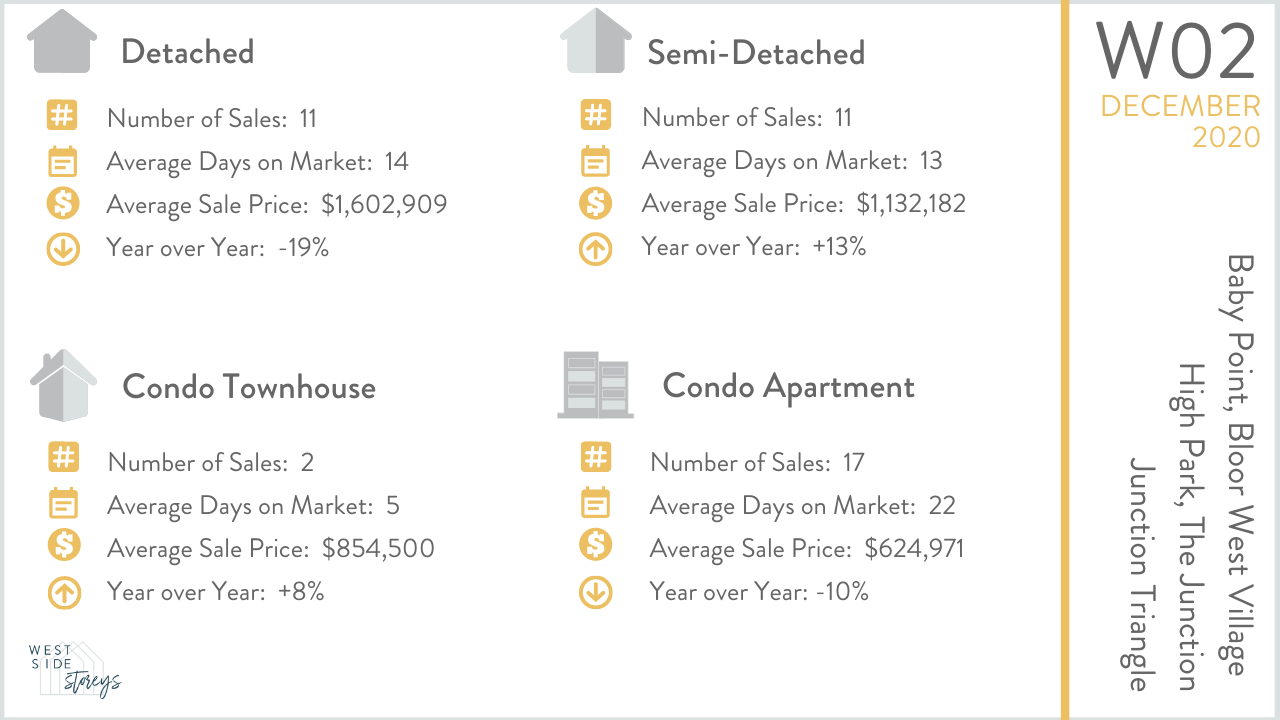
bloor_west_high_park_junction_real_estate.png

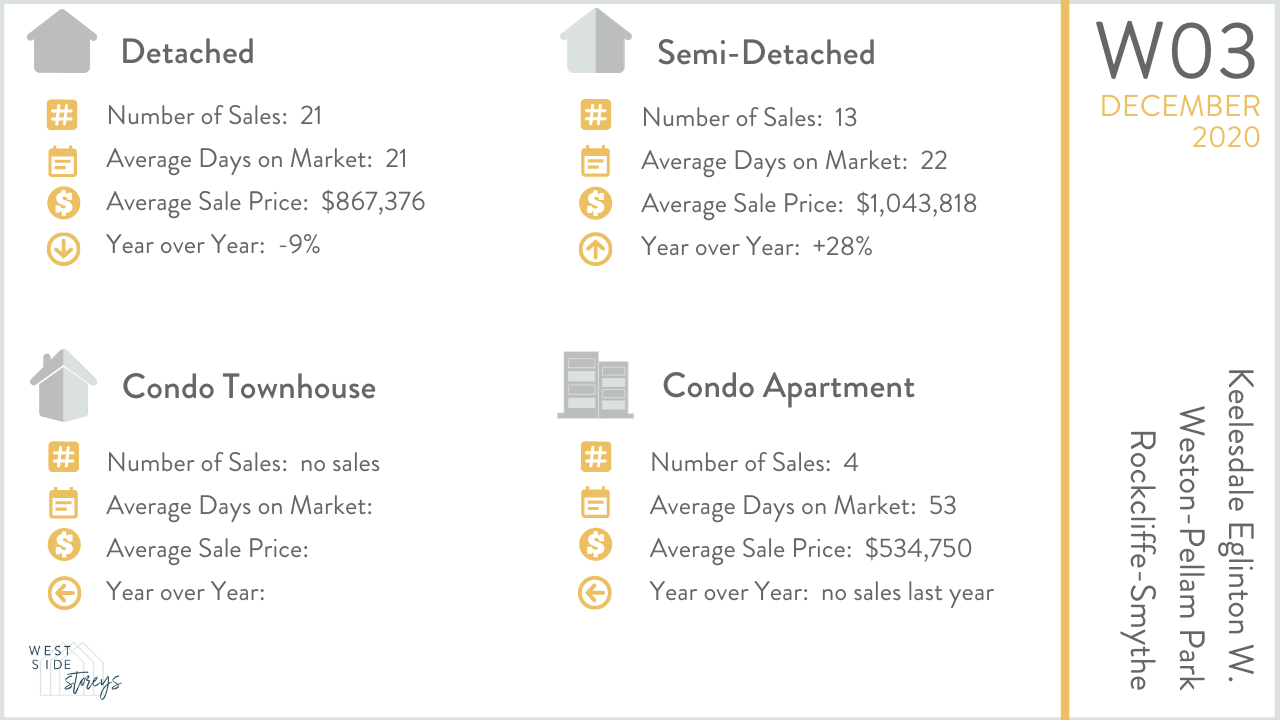
rockcliffe_smythe_real_estate.png

mimico_long_branch_new_toronto_real_estate.png

sunnylea_etobicoke_real_estate.png

the_kingsway_etobicoke_real_estate.png

Click here if you would like to compare these numbers to last month’s numbers.

If you would like further information about current market conditions, or if you are considering a move and would like to know how much your house is worth, feel free to get in touch, we are always available for your questions!

West End Toronto Real Estate Market Update - November 2020

1.png

The record pace of home sales in the fall continued with 8,766 sales reported in November by Greater Toronto Area REALTORS® through the Toronto Regional Real Estate Board’s (TRREB) MLS® System. This result was up by 24.3 per cent compared to November of last year.

Generally speaking, year-over-year growth in sales was stronger for single-family homes in the GTA regions surrounding the City of Toronto, but annual single-family growth rates remained robust in the ‘416’ area code as well. “Home buyers continued to take advantage of very low borrowing costs in November, especially those looking to buy some form of single-family home. Competition between buyers for ground-oriented homes has been extremely strong in many neighbourhoods throughout the GTA, which has continued to support double-digit annual rates of price growth,” said Lisa Patel, TRREB President.

The MLS® HPI Composite Benchmark was up by 10.6 per cent in November 2020 compared to November 2019. The average selling price for all home types combined was up by 13.3 per cent to $955,615.

Market conditions tightened in many single-family market segments in November, resulting in double-digit year-over-year increases in average selling prices for detached houses, semi-detached houses and townhouses.

In contrast to the single-family market segments, buyers continued to benefit from much more choice in the condominium apartment market compared to last year, particularly in the City of Toronto. The number of new condominium apartment listings in November was almost double that reported in November of last year. More options in the condo apartment market translated into a small year-over-year decline in the average condominium apartment selling price in the ‘416’ area code.

“The condominium apartment market is certainly more balanced than in previous years, with some buyers benefitting from lower selling prices compared to last year. However, this may be somewhat of a short-term phenomenon. Once we move into the post-COVID period, we will start to see a resumption of population growth, both from immigration and a return of non-permanent residents. This will lead to an increase in demand for condominium apartments in the ownership and rental markets,” said Jason Mercer, TRREB Chief Market Analyst.


roncesvalles_real_estate.png

the_junction_bloor_west_high_park_real_estate.png

rockcliffe_smythe_real_estate.png

mimico_long_branch_new_toronto_real_estate.png

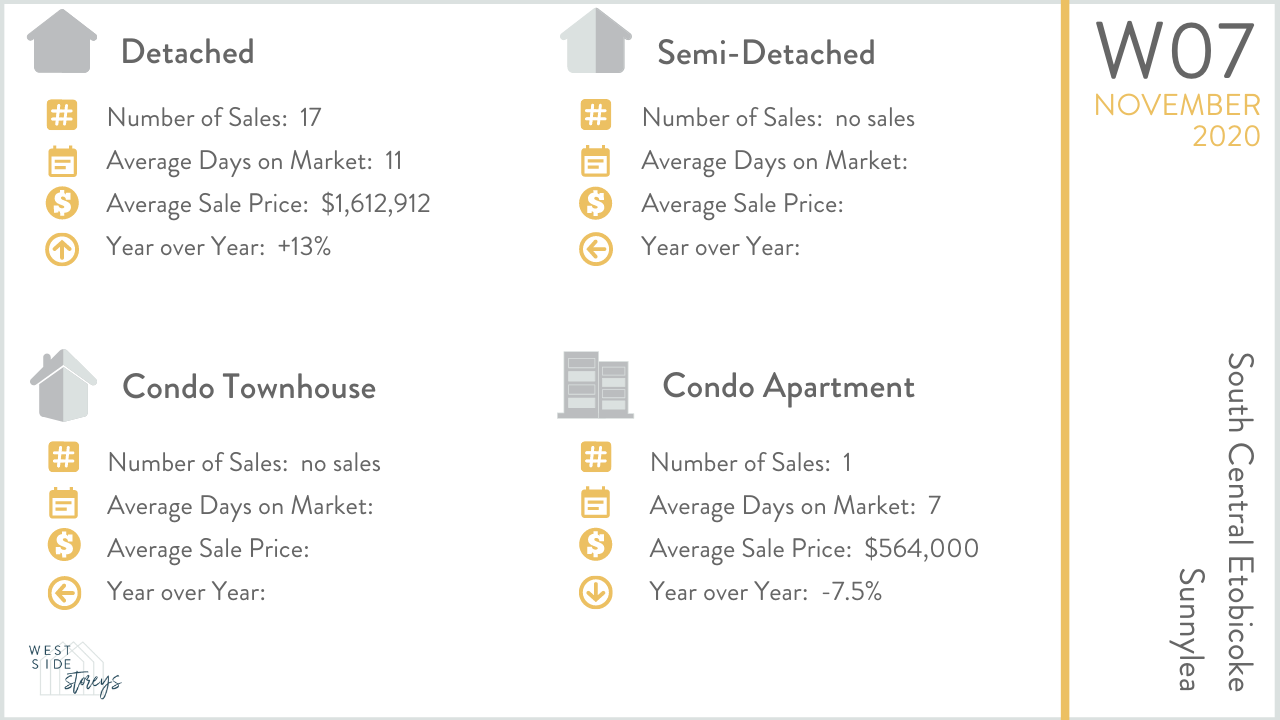
sunnylea_etobicoke_real_estate.png

central_etobicoke_real_estate.png

Click here if you would like to compare these numbers to last month’s numbers.

If you would like further information about current market conditions, or if you are considering a move and would like to know how much your house is worth, feel free to get in touch, we are always available for your questions!

navigating the west Toronto high school options for your grade 8 student

Toronto_high_schools.png

My youngest daughter is in grade 8 so I am doing this all over again, but as with everything, it is looking a lot different this year! Due to covid, all of the Toronto high school open houses are virtual this year, but we are still logging in and weighing our options. She will be graduating from Karen Kain School of the Arts (KKSA) so ESA is an option, as well as our home school and some of the specialty programs that are offered at other high schools, such as UFA and Western Tech. I will let you know how it goes!

Here is our annual guide to all the (virtual) open houses, programs, key dates and application deadlines for many of the West Toronto high schools.


Specialty Programs & Key Dates

Bishop Allen Academy (Catholic)

  • Congregated Advanced Placement Program - an internationally recognized program that fosters success in higher education by encouraging students to develop critical thinking skills at the highest level

  • application & strong academic performance in grades 7 & 8 required - applications are available as of October 8th and are due October 29th. Notification of acceptance to specialty programs is on November 27th (wave 1) & December 4th (wave 2)

Bloor Collegiate - Open house November 16th, 6:30-8:30pm

Etobicoke Collegiate - Open House November 26th, 7pm

Etobicoke School of the Arts - Open house November 16th, 7-9pm

  • arts focus in dance, drama, music & film

  • applications are available November 9th and the online application submission deadline is December 9th

  • acceptance dependent on audition - virtual auditions are being held January 15th, 2021. Offers of admission will be emailed in early February 2021


Father John Redmond (Catholic) - Virtual Open House

  • Congregated Advanced Placement Program (CAP)

  • Regional Arts Program (RAP) - applications available as of October 8th and are due October 28th (online) or October 29th (paper). Portfolio/Audition videos must be uploaded by November 13th and auditions will be conducted from November 18-20. Notification of acceptance is on November 27th (wave 1) & December 4th (wave 2).

  • Gifted & Enrichment Program

  • Update: apparently they have changed their application process and you can only apply to CAP if you have been accepted into Father Redmond through a feeder school or into the Regional Arts Program

Humberside Collegiate

  • extended french & french immersion programs for students coming from feeder schools

  • students in the english program must live within the school's catchment to attend

Martingrove Collegiate - Open house November 24th, 6:30 & 7:45

Parkdale Collegiate - Open house November 18th, 7pm

Richview Collegiate - Open house November 24th, 7-9pm (french) and November 25th, 7-9pm (english)

  • extended french & french immersion programs for students coming from feeder schools

  • students in the english program must live within the school's catchment to attend

Runnymede Collegiate - Open house December 2nd, 6pm

Ursula Franklin Academy

  • Integrated technology & academics for the real world with a focus on 5 core values: spirit of inquiry, democracy, social justice, community of learners, and connected knowledge

  • application required - applications due January 29th

  • if the number of eligible students exceeds the number of spaces available, a lottery will be held the first week of February and acceptance letters will be sent out February 12, 2021 and must be accepted by February 26th

Western Technical-Commercial School - Open house November 19th, 7pm

Please click here, for a list of open houses at all TDSB schools.  Happy open housing and the best of luck to all of you.....high school is a whole other post ;).